Steel buildings rely on more than just columns and beams. Hidden behind the roofing and wall cladding are structural components that play a critical role in the building's strength and stability. Among the most important of these are Z and C purlins. Although they are often overlooked, these secondary structural members help distribute loads, support roofing systems, and improve the overall performance of industrial buildings.
With industrial development expanding across Nagpur and Maharashtra, contractors, architects, and factory owners are increasingly opting for engineered steel structures that offer durability and design flexibility. RSR Steel Pvt. Ltd. supplies structural components for industrial projects, including high-quality Z and C purlins that support modern construction requirements.
Understanding their purpose can help project owners choose the right structural solution before construction begins.
What Are Z and C Purlins?
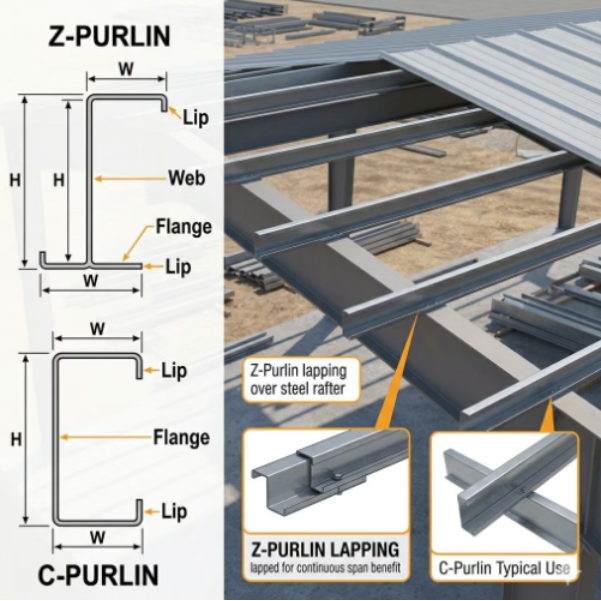
Z and C purlins are cold-formed steel sections installed horizontally between the primary structural frames of a building. Their primary function is to support roof sheets and wall cladding while transferring loads safely to the main steel framework.
The names are derived from their cross-sectional shapes.
- C Purlins resemble the letter 'C.'
- Z Purlins have a profile shaped like the letter 'Z.'
Although similar in appearance, each type is designed for different structural applications.
Why Purlins Are Essential in Steel Buildings
Without properly designed purlins, roofing sheets would lack the structural support needed to withstand wind, rain, and operational loads.
Their key functions include:
- Supporting roof panels
- Carrying wind and dead loads
- Improving structural stability
- Providing fixing points for roofing sheets
- Maintaining roof alignment
- Reducing stress on primary steel members
These benefits contribute to a stronger and more efficient building structure.
Z Purlins vs C Purlins
Choosing between Z and C purlins depends on the building's design, span, and structural requirements.
C Purlins
C purlins are generally used in:
- Wall cladding support
- Smaller industrial sheds
- End bays of buildings
- Mezzanine floor framing
Their symmetrical profile makes installation straightforward in many applications.
Z Purlins
Z purlins are preferred for:
- Large-span industrial buildings
- Long roof sections
- Continuous structural systems
- Warehouses
- Factory roofs
One of their major advantages is the ability to overlap adjacent sections, improving load distribution across longer spans.
Advantages of Using Engineered Purlins
Modern manufacturing techniques have made steel purlins an efficient alternative to traditional structural members.
Some notable benefits include:
Reduced Structural Weight
Cold-formed steel offers excellent strength while remaining lightweight, reducing the overall load on the building.
Faster Installation
Uniform manufacturing allows for quicker installation, helping contractors maintain construction schedules.
Better Material Efficiency
Engineered sections are designed to optimize steel usage without compromising structural integrity.
Corrosion Resistance
Quality purlins often feature protective coatings that enhance durability, particularly in industrial environments.
Applications Across Industries
Z and C purlins are widely used in:
- Manufacturing plants
- Warehouses
- Logistics centres
- Commercial complexes
- Agricultural buildings
- Automobile workshops
- Aircraft hangars
- Industrial storage facilities
Their versatility makes them suitable for projects of various sizes.
Common Mistakes When Selecting Purlins
Improper selection can affect the performance of the entire roofing system.
Some mistakes to avoid include:
- Choosing incorrect section sizes
- Ignoring span calculations
- Using unsuitable steel grades
- Inadequate corrosion protection
- Poor connection detailing
- Improper spacing between purlins
Consulting experienced structural professionals during the design phase helps prevent these issues.
How Local Conditions Influence Selection
Nagpur experiences intense heat, seasonal rainfall, and occasional high wind conditions. These environmental factors influence structural design and material selection.
Properly engineered purlins must account for:
- Wind loads
- Roof slope
- Roofing material
- Building height
- Industrial usage
- Future expansion possibilities
Considering these factors during planning improves both safety and long-term performance.
Selecting the Right Manufacturing Partner
Structural components should never be viewed as standard products. Every industrial project has unique engineering requirements that influence section size, spacing, and load-bearing capacity.
Working with experienced manufacturers ensures that structural members are produced according to project specifications and industry standards. Companies such as RSR Steel Pvt. Ltd. support industrial construction by supplying dependable steel building components tailored to diverse applications across Nagpur and Maharashtra. When designed and installed correctly, Z and C purlins become a vital part of a durable, efficient, and long-lasting industrial structure.