A foundation bolt purchase can fail before fabrication begins if the supplier receives only a diameter and quantity instead of an approved anchor schedule. By checking the design basis, specifying the complete bolt assembly, and testing the manufacturer’s control over materials, dimensions, documents, delivery, and site support, you can compare suppliers on evidence rather than claims.
Key takeaways
- Start with issued-for-construction anchor-bolt and base-plate drawings.
- Demand a complete bolt schedule covering dimensions, steel grade and quantities.
- Verify material certificates, manufacturing controls and test documents.
- Set dimensional and document checks before bolts are embedded in concrete.
Start With the Foundation and Equipment Drawings
Do not request a price from a foundation bolts manufacturer until the issued-for-construction base-plate and anchor-bolt setting drawing is in hand. The drawing must show bolt coordinates, diameter, projection above concrete, embedment, spacing, edge distances, orientation, tolerances, sleeve or template details, and finished grout level.
Check it against the latest equipment foundation and structural drawings; these are often revised separately, and releasing bolts from a general equipment drawing creates site rework.
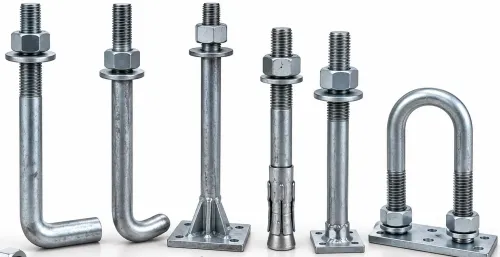
The anchor arrangement changes both fabrication and load transfer.
| Arrangement | What to confirm on the drawings | Typical application |
|---|---|---|
| J-shaped | Hook radius, straight length, embedment and orientation | Column bases and equipment foundations |
| L-shaped | Leg lengths, bend direction and edge distance | Light to moderate base fixings |
| Headed | Head dimensions, weld or forged detail and embedment | High-load column and equipment bases |
| Anchor-plate | Plate size, hole pattern, welds and concrete cover | Heavy structural frames |
| Sleeve or template system | Sleeve diameter, template position and bolt projection | Accurate equipment alignment and later adjustment |
Before approaching a supplier, assemble:
- The structural engineer’s anchor design, including concrete breakout, pull-out, pry-out, steel tension and shear, edge distance, spacing, embedment, and tension-shear interaction.
- The equipment manufacturer’s latest base-plate drawing and foundation general arrangement, with revision numbers.
- The project specification naming IS 5624, ASTM F1554, EN 14399, or another declared standard, plus grade, corrosion system, nuts, washers, and thread form.
- The required drawing revision, destination foundation, and template details.
The engineer selects the anchorage; the manufacturer fabricates it. This is the foundation of how to choose foundation bolts manufacturer in nagpur.
Turn the Approved Anchor Design Into a Complete Bolt Schedule
A quotation must describe the complete anchor assembly, not merely “M20 bolt.” Give the supplier the issued-for-construction base-plate and anchor-bolt setting drawing, the design load schedule, and the code basis for tension, shear, uplift, seismic, wind, accidental and erection loads. Do not accept informal advice to “use one size larger.”
Include these schedule fields:
- Anchor type and geometry: J, L, headed, bent-bar, anchor-plate or sleeve arrangement, with orientation and any template requirements.
- Material standard and grade for the bolt, plus the nut and washer class.
- Nominal diameter, total length, embedment depth, projection above concrete, thread length and thread form.
- Bolt coordinates, spacing, edge distances, installation tolerances, grout level and sleeve dimensions.
- Nut arrangement, washer outside diameter and thickness, levelling nuts, lock nuts and tightening requirements.
- Corrosion-protection system matched to the exposure: dry indoor space, roof-support foundation, cooling-tower or wastewater area, chemical zone, or buried and splash-zone location.
- Inspection documents, including heat or cast number, chemical and mechanical results, dimensional checks, coating records and packing identification.
For foundation bolts for industrial facilities in Nagpur, require the heat number to remain traceable from incoming steel through fabrication and dispatch. State that coated threads must not be cut, chased or repaired in the field without an approved method.
Release fabrication only against the latest drawing revision; independently revised base plates and bolt cages otherwise create expensive site rework.
Check Engineering Capability, Steel Control and Test Documents
Do not accept “M20 foundation bolt” as proof of capability. A foundation bolts manufacturer in Nagpur must confirm the declared standard, bolt grade, diameter, length, thread form, nut and washer class, corrosion-protection system, and anchor geometry shown on your approved drawing.
Ask for this evidence before placing the order:
- A sample dimensional inspection covering overall length, projection, bend or hook geometry, embedment length, plate position, thread length, diameter, spacing, and weld size where an anchor plate is used.
- A lot-wise material certificate naming the heat or cast number, chemical composition, mechanical properties, bolt grade, and test results. The heat number must remain traceable from incoming steel through fabrication and packing.
- Thread inspection records using calibrated GO and NO-GO gauges, with checks for pitch, thread length, damaged crests, nut fit, and end condition.
- Calibration certificates for callipers, thread gauges, torque equipment, and testing machines, with calibration dates that cover production and inspection.
- A declared conformity statement naming IS 5624, ASTM F1554, EN 14399, or the project specification. “IS standard” without a number and grade is not adequate.
- A nonconformance report showing how incorrect bends, short threads, coating damage, or mixed grades are isolated, corrected, and re-inspected.
- Bundle identification showing bolt mark, size, grade, quantity, heat or batch reference, drawing revision, and destination foundation or equipment.
Request comparable industrial-foundation references and production capacity for the required diameter and length. A certificate for generic, undated material does not prove that your delivered bolts conform.
Compare Nagpur Suppliers on Capacity, Coordination and Delivery
Judge a local supplier by evidence of control, not by the distance to your site. A foundation bolt supplier in Nagpur should show capacity for your required diameter, length and quantity, then coordinate bolt marks, templates, sleeves, nuts and washers with the erection sequence.
| Checkpoint | Reliable evidence | Warning sign |
|---|---|---|
| Capacity | Written production capacity for the required sizes, a sample dimensional inspection and calibrated measuring equipment | A promise of fast supply without a production plan |
| Coordination | Quotation tied to the latest drawing revision, with each assembly identified as loose bolts, welded plates, sleeves, templates or a complete cage | A price quoted only for “M20 bolts” |
| Delivery | Dated manufacturing, inspection and dispatch milestones; bundle labels showing mark, size, grade, quantity, heat or batch number, drawing revision and foundation destination | Mixed, unmarked bundles that cannot be matched at site |
Ask each foundation bolts manufacturer in Nagpur to name the governing standard and grade, such as IS 5624, ASTM F1554, EN 14399 or your engineered project specification. Require lot-wise certificates linking the heat number from incoming steel to the finished bundle, with chemical and mechanical results, dimensions, nut and washer grades, and test records.
Before awarding the order, request references for comparable industrial foundations and the supplier’s documented nonconformance and replacement process. RSR Steel Pvt. Ltd. should face the same checks: confirm who measures replacement bolts, who resolves drawing discrepancies, and how quickly corrected assemblies reach the erection team.
Related product
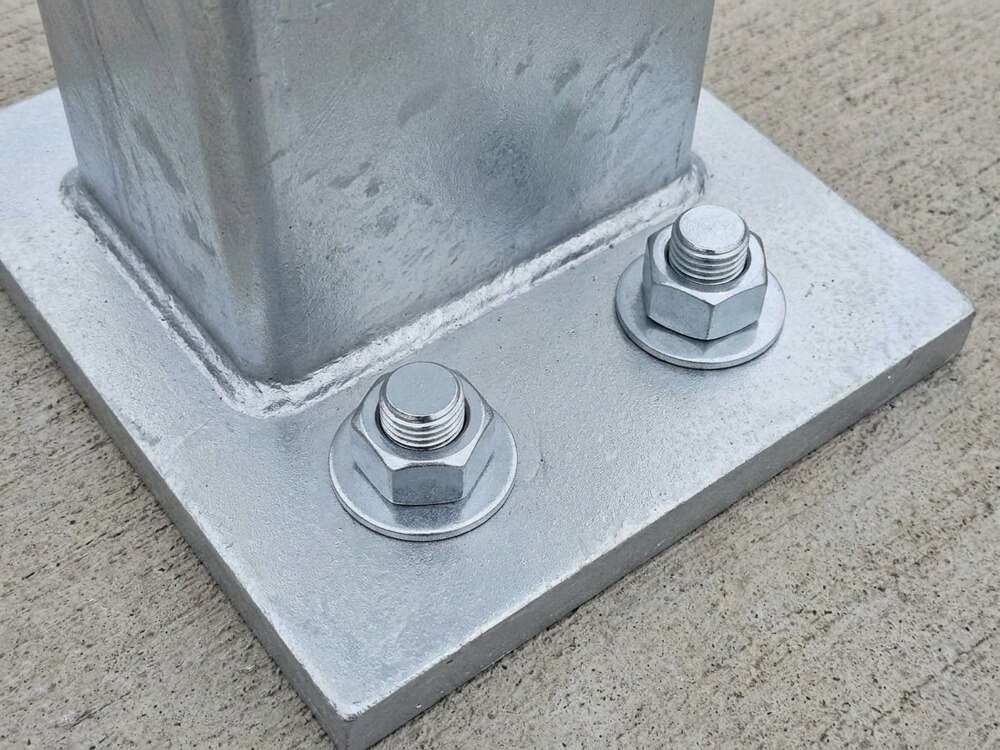
 | Foundation Bolts RSR Steel Pvt. Ltd. supplies robust Foundation Bolts engineered for secure anchoring of structures and heavy machinery. View product → |
Set Acceptance Checks Before the Bolts Reach Concrete
Do not release a bolt lot on diameter alone. Before dispatch, match every item against the issued-for-construction setting drawing and purchase specification, then record the result against its heat or cast number.
1. Confirm the bolt type, grade, diameter, overall length, embedment, projection, thread form and thread length. Check bolt coordinates, orientation, plate or hook geometry, sleeve details, template holes and grout level against the drawing. Reject any dimension outside the stated tolerance.
2. Inspect the supplied nuts and washers for the specified class, dimensions and coating compatibility. Run each matched nut over the full required exposed thread before packing. Reject damaged, crossed, short, obstructed or coating-clogged threads.
3. Obtain a lot-wise material certificate showing heat number, chemical composition, mechanical properties, bolt grade, nut and washer grade, dimensions and test results. Trace that heat number from incoming steel through fabrication and packing; reject generic or undated certificates.
4. Check the corrosion system against the actual exposure: indoor plant, roof-support foundation, cooling tower, wastewater, chemical, buried or splash-zone service. Protect coated threads from cement laitance and impact, and reject unauthorised field coating cuts or repairs.
5. Before installation, verify the template, bolt cage, projection, centre spacing and verticality against the base-plate drawing. Photograph measurements, record the inspector, date and lot number, and raise a nonconformance report for any mismatch. Do not pour concrete until disposition is approved.
These records provide a practical basis for how to choose foundation bolts manufacturer in Nagpur, especially for foundation bolts for industrial facilities in Nagpur where replacement and site coordination affect the programme.
Frequently asked questions
What drawings should you provide before requesting a foundation bolt quotation?
Provide the issued-for-construction base-plate and anchor-bolt setting drawing. It must show bolt coordinates, diameter, projection, embedment, spacing, edge distances, orientation, tolerances, sleeves or templates, and finished grout level.
What should a complete foundation bolt schedule include?
The schedule should identify each bolt mark, quantity, diameter, length, thread length, projection, embedment, bend or plate details, steel grade, nuts, washers, sleeves, templates and required tolerances.
Which engineering and quality documents should you request from a Nagpur manufacturer?
Request the approved anchor design, shop drawings, steel mill test certificates, heat or batch traceability, dimensional inspection records, thread or weld inspection results, and any specified test reports.
How can you compare foundation bolt suppliers in Nagpur?
Compare their ability to interpret drawings, manufacture the required sizes and assemblies, maintain traceability, coordinate revisions, meet project quantities, protect threads during transport and deliver to your concrete-pour schedule.
Keywords