Overload trips, brake slippage, uneven hoisting, skewing and rope damage rarely have a single cause. You need to separate the symptom from the failed component, then match the crane, runway, controls and operating method to measured loads and site conditions. By the end, you will have a practical specification and verification checklist for correcting lifting problems rather than masking them with a larger motor or higher rated capacity.
Key takeaways
- Record the load, travel direction and control command when failure occurs.
- Calculate required capacity from load weight, attachments, impact and duty cycle.
- Check runway alignment, building structure, power supply and site clearances.
- Require load-test evidence before accepting an EOT crane repair or replacement.
Trace the Failure Before Replacing the Crane
Start with the symptom, not the replacement decision. Record when the failure occurs, the lifted load, travel direction and control command; this pattern separates recurring EOT crane lifting issues from operator error or a one-off obstruction.
- For an overload trip or stalled hoist, measure the load and inspect reeving, wire rope, drum winding, brake, gearbox, hoist supply voltage and motor current.
- For brake slippage, check lining wear, oil contamination, adjustment and brake torque. An emergency stop cannot replace a hoist brake or load limiter.
- For uneven hoisting, check reeving errors, unequal rope lengths, drum damage and the hoist drive.
- Inspect ropes for broken wires, kinks, crushing, fleet-angle damage, heat and chemical attack; inspect slings for identification, angle, storage and removal-from-service damage.
- For trolley faults, check wheels, guide rollers, rail joints, drive synchronisation and obstructions. For bridge skewing, measure rail gauge, rail levels, wheel-flange wear, wheel diameters and end-carriage alignment.
- Inspect couplings, bearings, gears, brakes and loose structural connections when vibration or motor noise appears. Test upper limits, lower limits and overload devices separately.
| Symptom | Trace these causes | Do not assume |
|---|---|---|
| Overload or stall | Load, rope, drum, brake, gearbox, voltage, current | A larger motor is the cure |
| Skewing | Rails, wheels, rollers, alignment | Motor capacity is the cause |
| Limit failure | Upper, lower and overload circuits | Emergency stop provides protection |
These checks form useful EOT crane problem requirements before repair approval.
Calculate Capacity From the Load, Not the Tonnage on the Nameplate
A capacity decision starts with the complete load case, not the crane’s nameplate tonnage. Record these inputs before selecting among EOT crane industrial requirements or comparing EOT crane specifications in Nagpur:
1. Record the maximum lifted load, every below-hook device, load dimensions, centre of gravity, lifting height, hook approach, span, runway length, duty class, lifts per hour, operating hours per shift, lift speed, trolley and bridge travel speeds, control method, indoor or outdoor location, ambient temperature, corrosive exposure and available power supply.
2. Separate safe working load, rated capacity, maximum lifted load and dynamic load. Acceleration, braking, impact and suspended-load swinging add forces that static weight misses. Prohibit dragging, freeing stuck material and side pulling; keep the hook vertically above the load before applying tension.
3. For long or flexible steel sheets, roofing panels and polycarbonate products, specify spreaders or vacuum equipment, contact points, anti-scratch interfaces, allowable deflection and wind limits. Adequate tonnage will not prevent buckling, surface damage or swinging.
4. Calculate headroom separately: top-of-hook elevation, beam and trolley depth, minimum hook approach, sling length, load height and clearance above the highest obstruction. A larger crane will not solve insufficient headroom. Validate the duty cycle against load spectrum, lifts per hour, travel distance, positioning accuracy and downtime cost.
Include maximum wheel loads and safe access for inspection, isolation and lockout.
Match the Crane Type to the Work Pattern
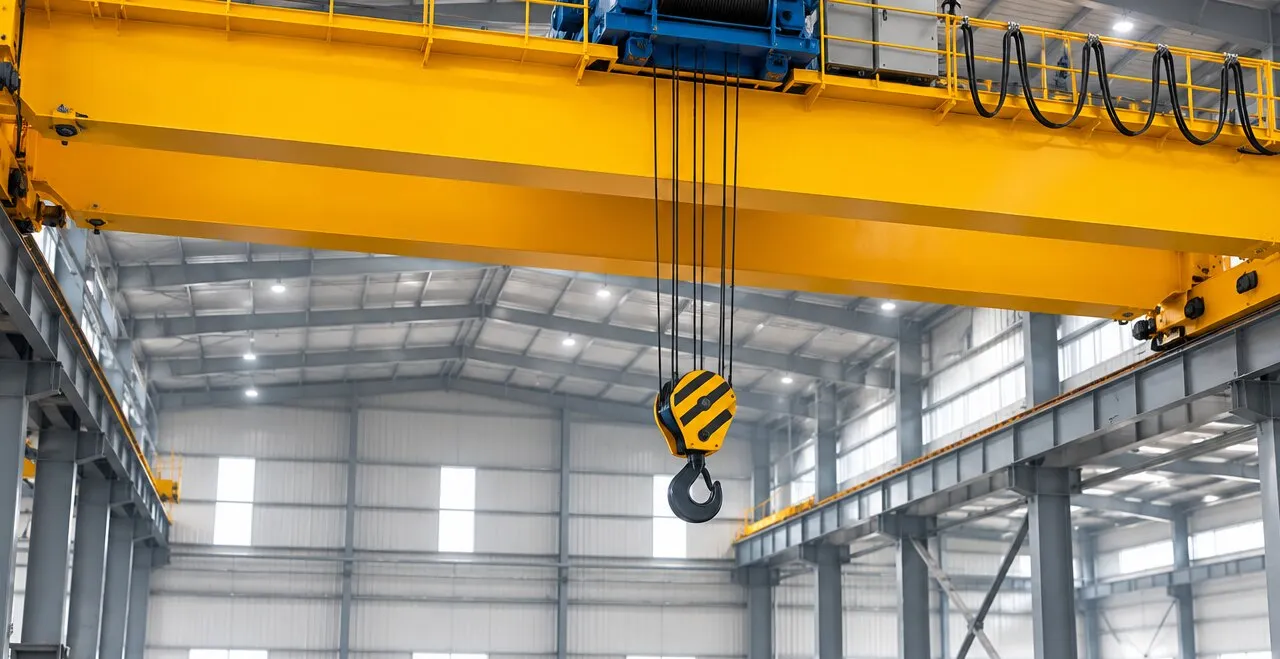
An EOT crane is the right answer when a fixed indoor runway can cover the loads, span, hook height and duty cycle without exceeding structural or fatigue limits.
| Option | Best fit | Main constraint |
|---|---|---|
| Single-girder EOT | Moderate loads, spans and duty cycles | Lower stiffness and service life at demanding duty |
| Double-girder EOT | Greater span, lifting height, stiffness, headroom or below-hook equipment | Higher self-weight, structure demand and purchase cost |
| Gantry crane | Outdoor yards or buildings unable to support a runway | Foundations, rails and wind loads |
| Monorail hoist | Fixed linear route with few transfer points | Cannot serve multiple areas freely |
| Jib crane | Local workstation lifting and short outreach | Limited coverage and capacity |
| Forklift | Palletised loads and flexible floor movement | Needs clear floor routes; no overhead reach |
| Mobile crane | Temporary, outdoor or changing locations | Setup space, ground-bearing checks and mobilisation |
Choose a single-girder crane when its lower self-weight reduces runway demand. Choose double-girder construction when stiffness, maintenance access or service life justifies it. Compare lifecycle access to brakes, motors, ropes, panels and gearboxes, not only the quoted price.
For eot crane requirements for lifting problems in Nagpur, check adjacent cranes, end-stop clearance, obstructions, signal-person communication and exclusion zones. A crane with enough tonnes still fails if it cannot reach or position the load safely.
For recurring EOT crane lifting issues, use a forklift where overhead coverage is unnecessary. Select a mobile crane for temporary work, not a permanent production route. A no-load test cannot prove rated-load braking or safe interaction with production.
Verify the Runway, Building and Site Conditions
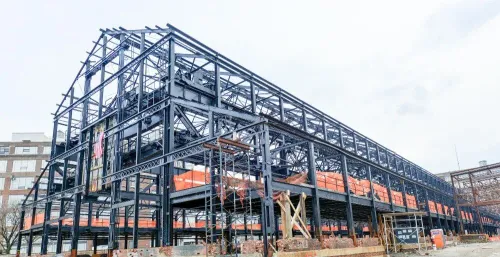
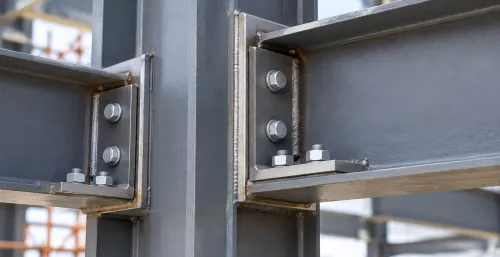
Before purchase, verify that the building can carry the crane’s actual reactions, not just its rated tonnes. For an existing shed, commission a structural survey covering runway beams, end carriages, rail-seat details, columns, brackets, foundations, building clearances and power-collection routes.
The structural engineer must check maximum vertical wheel loads, horizontal surge loads, longitudinal braking loads, rail alignment, rail-gauge variation, rail-level difference and local column or bracket stresses. Supplier runway reactions do not prove that an existing PEB or factory is adequate; compare wheel loads with the actual runway and building drawings.
| Installation stage | Evidence to verify | Failure if skipped |
|---|---|---|
| New installation | Crane loads, runway supports, foundation interfaces, conductor bars or cable reels, clearances and maintenance access are coordinated in the design | Later structural changes, blocked access or unsuitable power collection |
| Retrofit | Survey measurements, rail condition, column and connection capacity, foundation capacity and required reinforcement are confirmed | Skewing, overstressed supports, rail damage or unsafe operation |
For eot crane industrial requirements, include walkways or platforms, brake and panel access, lighting, isolation points, lockout provisions and clearance from adjacent equipment. If maintenance requires a roof, ladder or improvised platform, the specification is incomplete.
For outdoor or semi-outdoor service, eot crane requirements for lifting problems in nagpur must address monsoon drainage, water ingress, dust, corrosion, enclosure ratings, panel location, condensation and wind exposure. A nominal indoor configuration is not automatically suitable for an open-sided bay.
Check rail alignment and access routes before commissioning; no-load travel cannot prove safe rated-load braking.
Procure Against Evidence and Prove the Repair Under Load
Compare proposals against documented interfaces, not quoted tonnes. Strong EOT crane problem requirements expose the assumptions behind capacity, recurrence risk and downtime.
| Document | Compare | Reject or query |
|---|---|---|
| General arrangement | Span, hook approaches, top-of-hook elevation, beam and trolley dimensions, clearances and maintenance access | Missing dimensions or roof-dependent maintenance |
| Engineering data | Wheel-load schedule, motor and brake data, duty classification, reeving diagram and runway reactions | Standard values unrelated to the structural survey |
| Controls and protection | Electrical single-line, control philosophy, enclosure details, overload protection and upper/lower limits | Emergency stop offered as a substitute for brake or load limiter |
| Assurance and support | Test records, inspection documents, spare-parts list and response-time commitments | No acceptance evidence or defined service response |
Ask every bidder to state assumptions for load spectrum, lifting and travel speeds, power supply, ambient conditions and runway reactions. For replacement work, compare those figures with measured rails, columns, brackets, foundations and electrical routes. Do not accept a standard configuration because the span and rated capacity look correct; inadequate headroom remains a geometry failure.
RSR Steel Pvt. Ltd. belongs in an EOT crane specifications in Nagpur comparison only when it supplies these crane-specific documents and coordinates the equipment with the verified shed, runway and electrical interfaces.
Commissioning must include no-load travel, rated-load lifting, normal and emergency braking, upper and lower limits, overload protection, trolley and bridge travel, skew behaviour and the worst expected runway reactions. A no-load run proves neither rated-load braking nor structural response.
Before production release, record defects, corrective actions, inspection intervals, operator signals, exclusion zones and lockout procedures. Require a signed retest for every corrected defect.
Related product
 | EOT Crane RSR Steel Pvt. Ltd. offers robust EOT Cranes engineered for efficient material handling in industrial environments. View product → |
Frequently asked questions
How do you trace an EOT crane lifting problem before replacing the crane?
Record when the failure occurs, the lifted load, travel direction and control command. Inspect for obstructions, operator-control faults, brake or hoist problems, power interruptions and recurring mechanical defects before choosing replacement.
How should you calculate EOT crane capacity for a lifting problem?
Start with the heaviest load, then include lifting attachments, below-the-hook equipment, dynamic effects and the required duty cycle. Do not rely only on the crane’s nameplate tonnage.
What building and site conditions must you verify for an EOT crane?
Check runway beam capacity, rail alignment, span, headroom, wheel loads, building columns, power supply, travel clearances and access for maintenance. Confirm these dimensions against the proposed crane specifications.
What evidence should you require after an EOT crane repair?
Require inspection records, replaced-part details, brake and limit-switch checks, unloaded functional tests and a documented load test using the agreed test load and acceptance criteria.
Keywords