A cleat is a designed force-transfer component, not simply a piece of angle cut to length. By the end, you will know how to define its geometry, verify its strength, prepare a fabrication package, and obtain a quotation that accounts for bolts, welds, coatings, tolerances, and site conditions.
Key takeaways
- Define the cleat from the load path and erection sequence.
- Check bolt spacing, welds, thickness, buckling, and member capacity.
- Name IS 800, IS 2062, IS 808, and required inspection documents.
- Send drawings, loads, steel grades, quantities, and delivery details for quotations.
What a Cleat Is and Where Steel Frames Use It
A cleat is an angle, plate, tee, end plate, fin plate, or other fabricated component that transfers shear, tension, compression, or combined forces between steel members. Its form depends on the load path and erection sequence, not on a universal product size.
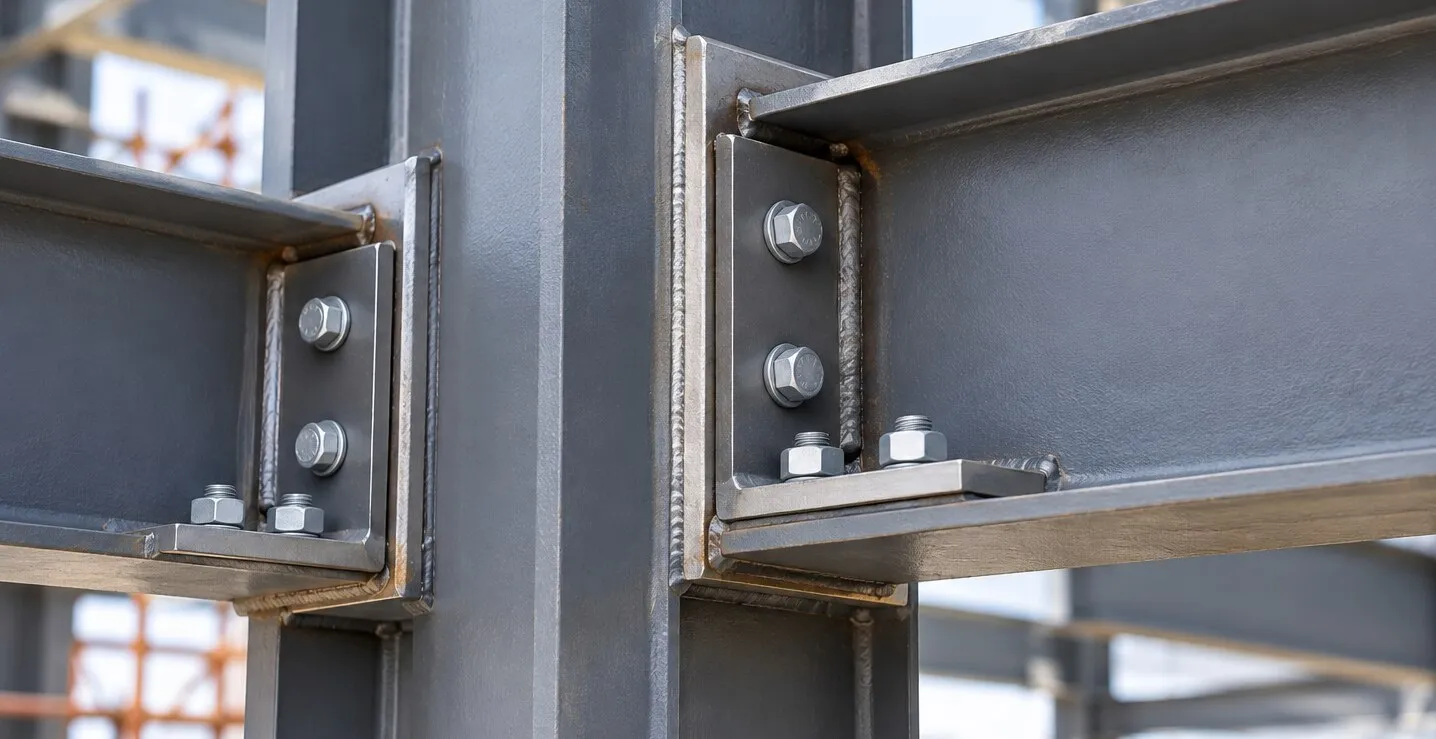
- Beam-to-column shear tabs use a welded fin plate or angle to transfer beam end shear through site bolts.
- Angle cleats connect members through one or both legs where simple bolted access is needed.
- Seating cleats use a seat plate or seated angle to carry beam reactions in compression.
- Splice cleats join aligned beam or column segments and transfer force across the splice.
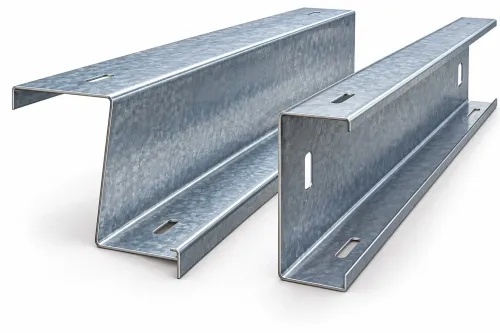
- Purlin cleats attach cold-formed or rolled purlins to rafters and frames.
- Bracing cleats connect diagonal tension or compression members to gusset plates or columns.
- Equipment-support cleats carry concentrated loads from platforms, pipes, ducts, or machinery frames.
A shop-fabricated cleat is not simply a length of rolled angle. It has a specified cut length, drilled or slotted holes, welded studs where required, stiffeners, a seat plate, a piece mark, and connection-specific geometry such as coping, notches, or clearances.
Steel cleat connection details must also identify the connected member sizes, forces, bolt and weld arrangement, and whether the connection is shop-welded and site-bolted.
“Standard cleat” is incomplete without connected member sizes, reaction forces, erection method, and drawing reference. A cleat specification for fabricators must define those items before cutting or drilling begins.
Dimensions and Strength Checks That Control the Detail
Steel cleat connection details must show the cleat’s leg dimensions, thickness, profile, cut length, bolt diameter and grade, actual hole diameter, gauge, pitch, end distance, edge distance, bolt-group arrangement, weld size and length, and connection length. State whether the detail uses an angle, tee, fin plate, end plate, or another profile.
A beam-to-column shear cleat carries the design shear plus an eccentric moment from the offset between the bolt-group centroid and the reaction line or shear centre. Designing for bolt shear alone can understate cleat bending, weld demand, and forces transferred into the supporting member.
| Edge condition | What the drawing must identify | Why it matters |
|---|---|---|
| Rolled | Rolled edge and available edge distance | IS 800 limits still govern |
| Machined | Machined edge and finished dimension | Permitted distance differs from rough edges |
| Sheared | Shearing process and trimmed edge | Tear-out risk rises near the minimum |
| Flame-cut | Flame-cut edge and inspection condition | Heat-affected or rough edges need control |
Under IS 800:2007, record these checks before fabrication release:
- Bolt shear and bolt tension where present
- Bearing on the bolt and connected material
- Net-section rupture and block shear
- Gross-section yielding
- Cleat bending and prying
- Bolt slip where a slip-resistant connection is specified
- Weld strength, effective throat, effective length, and eccentricity
- Local buckling of the cleat or outstanding leg
- Capacity of the connected beam, column, or supporting plate
Indian Standards and Material Choices for Fabrication Release
Before cutting, verify the drawing and purchase order identify steel grade, product form, thickness, bolt grade, and connection type. “Mild steel cleat” is not a release instruction.
IS 800:2007 governs steel design and connection checks. Use IS 808 for standard hot-rolled angles and other listed sections, and IS 2062 for structural steel plates, flats, and sections. IS 1363 and IS 1364 cover common black hexagonal bolts and nuts; use IS 3757 for high-strength structural bolts where the design specifies them.
| Connection type | Required fabrication basis | Do not substitute |
|---|---|---|
| Ordinary bearing | Bolt grade, hole size, bearing and shear checks | Do not replace the specified grade without approval |
| Preloaded HSFG | Bolt system, faying-surface preparation, tightening method, pretension verification, inspection records | Ordinary 4.6 or 8.8 bolts are not equivalent |
The cleat specification for fabricators must state whether bolting is ordinary bearing-type or preloaded HSFG, including the exact tightening and inspection requirements for HSFG work. Retain the mill test certificate, heat number, grade, thickness, and every specified impact-test or delivery-condition requirement.
Check that the material record matches the piece mark before cutting. Record the edge-cutting process when bolt holes approach minimum edge distances; flame-cut, sheared, machined, and rolled edges are not interchangeable under IS 800.
There is no Nagpur-specific cleat design code. Cleat fabrication requirements in Nagpur remain governed by IS 800:2007, the project and consultant documents, and applicable fire, seismic, and approval conditions.
The Fabrication Specification and Inspection Package
Before cutting steel, a complete cleat specification for fabricators must identify the connection geometry, manufacturing controls, coating route, and inspection evidence—not just “50 × 50 angle.” The cleat fabrication requirements in Nagpur should carry the latest approved drawing and connected-member reference.
1. Specify the steel grade, angle or plate profile, thickness, cut length, piece mark, drawing revision, and connected beam, column, purlin, brace, or equipment reference.
2. Give hole diameter, hole pattern, gauge, pitch, edge and end distances, and slot dimensions where slots are permitted. State dimensional and hole-location tolerances, bolt grade, weld category, weld size, length, continuity, and symbols.
3. Attach an approved welding procedure covering joint preparation, consumable classification, welding position, preheat and interpass controls where required, visual and other specified inspection, acceptance criteria, and repair method. Do not infer weld size from cleat thickness alone.
4. Inspect and record material identification, dimensions, hole size and location, fit-up, root gap, angle-heel interference, weld visual quality, short returns, distortion, and coating damage. Reject unapproved field-measured holes and repair defects before dispatch.
5. State whether the cleat is shop-primed, fully painted, hot-dip galvanized, or prepared for site coating. Define surface preparation, coating thickness, exposed-edge treatment, weld-spatter removal, and repair materials.
6. For galvanizing, show vent and drain holes, handling points, distortion allowances, threaded-component protection, coating repairs, and isolation from dissimilar metals and wet debris.
7. Require the supplier to submit a drawing and inspection package for approval before batch production; approval of one sample does not approve other piece marks or bolt groups.
What to Send a Nagpur Supplier Before Requesting a Quote
A cleats supplier in Nagpur can quote accurately only from a controlled connection package, not “standard cleats.” Send the complete information before fabrication so price, capacity, fit-up, and delivery do not change later.
1. Send connection drawings, approved connection schedules, piece marks, member references, design reactions, connected member sizes, steel grade and product form, bolt grade, weld symbols, weld sizes and lengths, quantities, required delivery date, and the exact site location within or around Nagpur, Maharashtra, India.
2. Add cut lengths, bolt lists, hole templates or CNC data, hole diameters and types, tolerances, coating requirement, inspection and test plan, packing requirements, and traceability rules. State whether each hole is drilled, slotted, or field-adjusted, and whether seat plates, stiffeners, or welded studs are included.
3. Require the supplier to submit shop drawings for approval before batch production. The drawing must identify the angle, tee, end plate, fin plate, or other cleat geometry and record material certificates, heat numbers, dimensional checks, hole inspection, weld inspection, coating records, packing, and delivery control.
4. Treat site-measured deviations as controlled changes, not fabrication shortcuts. Require designer approval before slotting, oversize holes, packing plates, reaming, or weld modifications, with the change recorded in as-built documents. RSR Steel Pvt. Ltd. can be compared with other suppliers, but assess every bidder against these controls and its ability to manage site deviations.
These documents define the cleat fabrication requirements in Nagpur and prevent an approved sample from being mistaken for approval of every bolt group.
Related product
 | Cleats Cleats RSR Steel Pvt. Ltd. offers precision-engineered Cleats designed for strong and reliable structural connections in steel buildings. |
Frequently asked questions
What is a cleat in steel connection fabrication?
A cleat is a fabricated angle, plate, tee, end plate, fin plate, or similar component that transfers forces between steel members.
What controls the dimensions of a steel cleat connection?
The load path, shear and tension forces, bolt spacing, weld capacity, plate thickness, buckling risk, connected-member capacity, and erection sequence control the detail.
Which Indian standards should fabricators reference for steel cleats?
The specification should identify applicable requirements from IS 800 for steel design, IS 2062 for structural steel grades, and IS 808 for hot-rolled sections where relevant.
What should you send a Nagpur cleat supplier before requesting a quote?
Send connection drawings, design loads, steel grades, cleat dimensions, bolt and weld details, quantities, tolerances, coating requirements, inspection documents, and delivery location.
Keywords